Owl Type II (Slot in Book)
by F.H. Griffith - HOBBIES Magazine - October, 1982
 Following through with last month’s article on the Owl (Turns
Head), we have at this time another Owl, which is quite different, as No. 299 in the
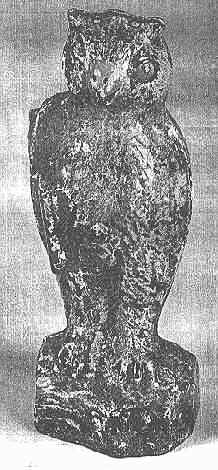
numerical classification. This bank, Owl, Type II (Slot in Book), frankly speaking, does
not have the quality and fine workmanship as compared to the Stevens Owl (Turns Head).
This is not meant to demean the bank in any way, but, simply stated, the characteristics
of an owl are not particularly well represented by this bank.
Following through with last month’s article on the Owl (Turns
Head), we have at this time another Owl, which is quite different, as No. 299 in the
numerical classification. This bank, Owl, Type II (Slot in Book), frankly speaking, does
not have the quality and fine workmanship as compared to the Stevens Owl (Turns Head).
This is not meant to demean the bank in any way, but, simply stated, the characteristics
of an owl are not particularly well represented by this bank.
Once again the bank pictured is from the fine collection of Wally Tudor of Chicago, Illinois. It is in reasonably good original condition, especially for this bank. It bears mention that for one reason or another this Owl Bank is more often than not usually found in fairly beat up condition. The paint seemed to chip very readily with any usage. On the other hand, some examples have been found in excellent condition, but this does not happen too often.
The bank is a rather late item and unusual is the fact that it was designed by a woman. It is one of a ‘family’ of mechanical banks, all designed by M. Elizabeth Cook prior to 1926. The mechanicals in the ‘family’ are Blinky the Owl pictured herewith, Blinky the Owl (Owl, Type I, Slot in Head), Flop Ears the Rabbit (Rabbit in Cabbage), Jug-O-Rum the Frog (Frog on Rock), and Pokey the Turtle (Turtle Bank). They were all manufactured by the Kilgore Manufacturing Company, Toytown Workers Division, Westerville, Ohio. Kilgore in the 1926 period advertised the banks as ‘The Toytown Workers Group of Animal Banks’ and ‘The Thrifty Four.’
The bank is an overall light tan with highlighting in brown in a toned or shaded fashion. The beak is yellow, as are the eyes which have black pupils. To operate the bank, a coin is pushed into the provided slot which is in a book held in the right wing of the owl. Pushing the coin in this slot causes the eyes to move or blink. A key lock coin trap is located in the stump base of the bank for removal of coins.
In closing, it should be noted that this Owl is the easiest member of the ‘family’ to obtain — the really tough one is the Turtle.
